
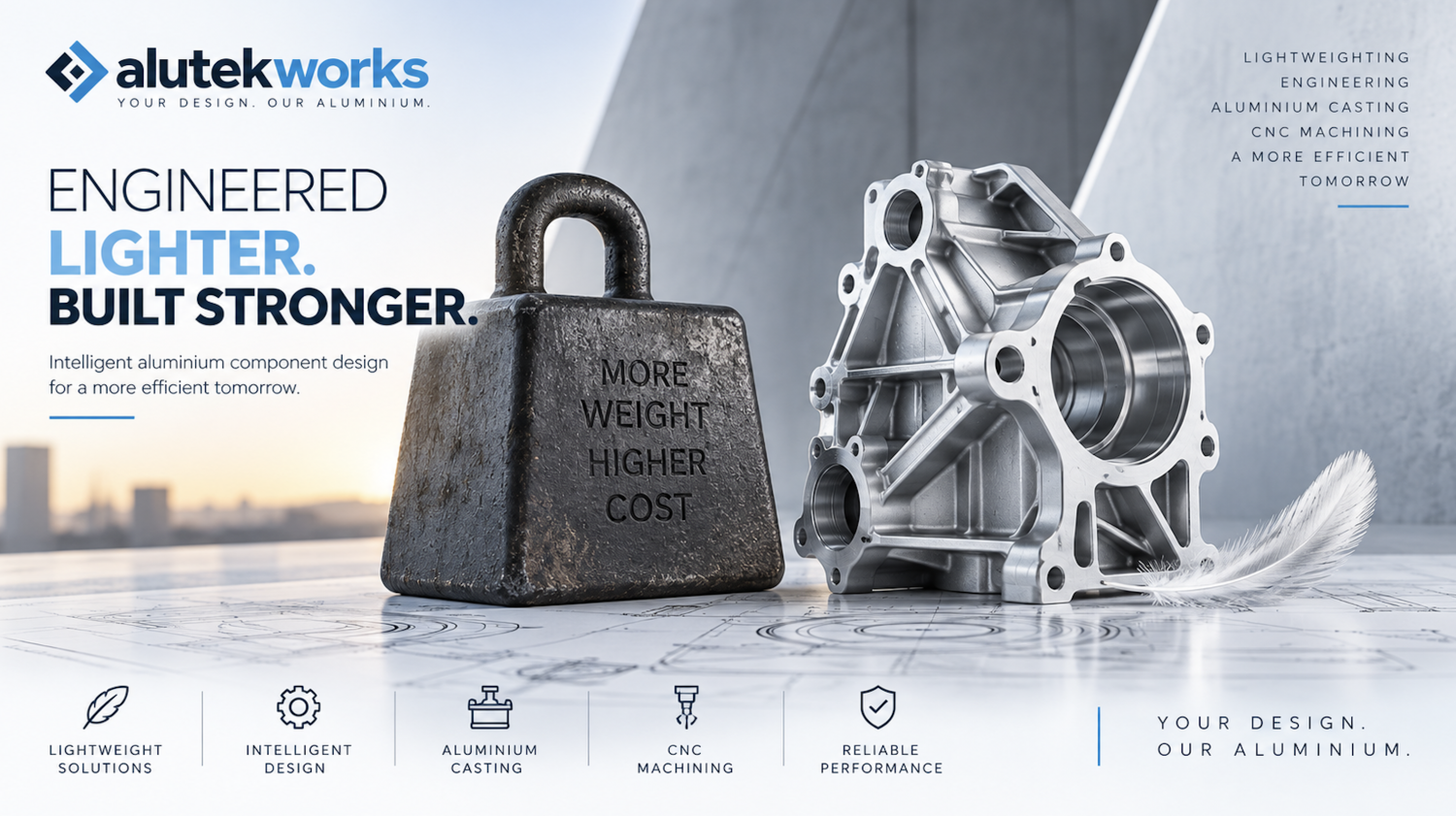
Lightweight Does Not Mean Weak
The Engineering Balance Between Low Weight, Strength and Intelligent Aluminum Component Design
One of the most common generalizations about engineering materials is:
Heavy means strong. Lightweight means weaker.
At first glance, this may seem logical. From the perspective of modern engineering, however, it is far too simplistic.
The performance of a component is not determined by its weight alone. Its mechanical properties, geometry, load paths, wall thicknesses, ribs, connection points, manufacturing process and even the direction in which forces are applied must all be considered together.
Aluminum is one of the best examples of this.
With a density of approximately 2.7 g/cm³, aluminum is roughly one-third the density of steel. But this does not mean that an aluminum component with exactly the same geometry will automatically provide the same stiffness or load-carrying capacity as its steel equivalent.
That is not the real engineering question.
The real question is:
How can we achieve the required function and durability with the most efficient possible mass?
This is where lightweight engineering begins.
Lightweight Is a Material Property. Durability Is a System Result.
The density of a material is a physical property.
The durability of a component, however, is not determined by material density alone.
For example, the performance of a load-bearing housing may be influenced by the combined effects of:
· alloy selection,
· yield and tensile strength,
· elastic modulus,
· cross-sectional geometry,
· wall thickness,
· rib structure,
· load paths,
· connection points,
· stress concentrations,
· casting quality,
· heat treatment,
· operating temperature,
· fatigue loading,
· corrosive environment.
For this reason, comparing two components only by their weight is not sufficient from an engineering perspective.
We need to evaluate not the material alone, but the combination of material + geometry + process + load.
“Strong” and “Stiff” Are Not the Same Thing
One of the most important distinctions in lightweight component design is the difference between strength and stiffness.
In simplified terms, strength relates to how much load a material can withstand before damage such as permanent deformation or fracture occurs.
Stiffness, on the other hand, relates to how much deformation occurs under load.
These are not the same property.
The elastic modulus of aluminum alloys is typically around 69–72 GPa, while for steels it is approximately 200 GPa.
Therefore, when aluminum and steel components with identical geometry are compared, the aluminum component will generally exhibit greater elastic deformation.
This reveals an important fact:
Simply replacing a steel component with aluminum while keeping exactly the same geometry is often not the correct lightweighting strategy.
The component must be reconsidered for aluminum.
Lightweight Engineering Is Not Material Substitution. It Is Geometry Redesign.
Aluminum's low density gives designers a different kind of freedom.
In certain applications, part of the weight advantage can be used to:
· resize wall sections,
· introduce ribs,
· increase section depth,
· reinforce local areas,
· optimize load paths,
· remove unnecessary material from other regions.
The component geometry can therefore be designed to carry loads more efficiently.
The central idea is:
A lightweight component is not necessarily a thinner component. It is a more efficiently designed component.
A lightweight component does not mean making every region thinner.
Some areas may require more material, while others may require less.
Engineering success is not about removing material randomly.
It is about putting material where it is needed.
Geometry Can Be as Important as the Material Itself
Consider a simple flat plate and a ribbed housing.
Both may be manufactured from the same material.
But they do not necessarily behave in the same way under load.
Changing the cross-sectional geometry, moving material farther from the neutral axis or using appropriately designed ribs can significantly influence bending stiffness.
This is why modern cast components frequently incorporate:
Ribs
Bosses — Local connection and reinforcement features
Hollow Sections
Variable Wall Thickness
These are not merely geometric details.
They are engineering tools for placing material where the function requires it.
One of the important design advantages of aluminum casting is the ability to integrate complex geometries into a single component.
This can create new opportunities for lightweighting.
Why Does Strength-to-Weight Ratio Matter?
In lightweight engineering, absolute strength alone is often not enough.
The amount of mechanical performance a material provides for a given mass also matters.
This is where specific strength, broadly understood as strength relative to density, becomes important.
A material may have lower absolute strength than another material, yet because of its much lower density it may offer competitive performance when evaluated on a weight basis.
This is one reason aluminum alloys have long played an important role in aerospace, automotive, railway and moving machinery systems.
Because in these applications the question is not only:
“How much load can it carry?”
It is also:
“How much mass must we carry in order to carry that load?”
Not Every Kilogram Has the Same Value
If a component is used in the foundation of a stationary factory machine, a difference of several kilograms may have limited importance.
But the same kilogram can have a very different engineering value if it is:
· continuously accelerated and decelerated in a vehicle,
· transported hundreds of thousands of kilometers on a train,
· located at the end of a moving robotic arm,
· part of the moving section of a conveyor system,
· carried on an aircraft,
· or sent into space.
The economic and technical value of lightweighting is therefore application-dependent.
Reducing one kilogram does not mean the same thing in every product.
This leads to an important principle:
Lightweighting should have a functional reason.
Low weight is not an objective by itself. It is an engineering tool used to improve system performance.
A Lighter Component Can Mean a Lighter System — and Sometimes the Effect Goes Further
Reducing the mass of a component can sometimes create benefits beyond the weight reduction of the component itself.
For example, in a moving system, a lighter component may create a chain such as:
Lower Component Mass
↓
Lower Moving Mass
↓
Potential for Lower Actuator / Motor Load
↓
Potential for Smaller Supporting Structures
↓
Lower System Mass
These secondary effects do not occur in every application.
But where they do occur, lightweighting moves beyond component optimization and becomes system optimization.
Casting Can Be an Important Tool for Lightweight Design
Machining a component from a solid block and casting a component close to its final geometry before machining only its critical areas are not the same material strategy.
Casting can allow engineers to place material where it is functionally required.
For example:
· local ribs,
· mounting bosses,
· internal cavities,
· complex transitions,
· integrated mounting features
can be incorporated into a single casting geometry.
When this approach is combined with near-net-shape manufacturing, the component can be produced relatively close to its final geometry, while CNC machining can be concentrated on critical functional surfaces.
The result:
Casting creates the geometry. CNC creates the precision.
But lightweight design still does not mean uncontrolled material reduction.
Excessively thin walls can negatively affect:
· mold filling,
· solidification,
· mechanical behavior,
· distortion risk,
· process stability.
Lightweight component design must therefore be evaluated together with manufacturability.
Less Metal Does Not Always Mean Better Design
This point is particularly important.
If an engineer can remove 20% more material from a component, it does not mean the component has become 20% better designed.
Excessive material reduction can lead to:
· local stress concentrations,
· insufficient stiffness,
· fatigue problems,
· vibration,
· deformation,
· casting problems,
· CNC fixturing problems,
· shorter service life.
In such a case, component reliability may be sacrificed in order to save only a few hundred grams.
True lightweighting is not the pursuit of:
Minimum Mass
but:
Minimum Necessary Mass
That single word changes the entire engineering approach.
Durability Is More Than Static Strength
The ability of a component to withstand a single high load in a laboratory does not mean that it will operate reliably for a long time under real service conditions.
Other factors may also become important when durability is evaluated:
Fatigue
Repeated loading can generate damage over time.
Vibration
This can be particularly important in machinery, automotive and railway applications.
Corrosion
Environmental conditions can influence long-term component performance.
Temperature
Material properties can change with operating temperature.
Impact
In some components, sudden loads may be more critical than static loads.
Therefore:
Strong today does not automatically mean durable for twenty years.
Real component design must consider not only the maximum load, but the entire service life.
Lightweight and Durable Are Not Opposites
At this point, the basic misconception can be removed.
The engineering problem is not:
Lightweight OR Durable
The correct problem is:
Lightweight AND Durable
Achieving this requires:
Material Selection + Alloy + Geometry + Casting Process + Heat Treatment + CNC Machining + Surface Protection + Quality Control
to work together.
A successful lightweight component is therefore not simply the result of a good alloy.
It is the result of a good manufacturing system.
Lightweighting Can Also Affect Carbon Footprint — But Not Automatically
In previous Journal articles, we discussed low-carbon manufacturing and circular material use.
Lightweighting can also be relevant here.
Lower mass may contribute to:
· lower material use per component,
· lower transported mass in certain applications,
· potential energy advantages in moving systems.
However, the principle we emphasized earlier still applies:
Being lighter does not automatically mean being more sustainable.
If the lighter component:
· requires a much more energy-intensive manufacturing route,
· generates high scrap rates,
· has a short service life,
· needs frequent replacement,
the overall lifecycle result may be different.
Lightweighting, durability and sustainability must therefore be considered together.
Not the Lightest Component — the Most Efficient Component
When evaluating an OEM component, asking only:
“How many more grams can we remove from this part?”
is an incomplete approach.