
Today, aluminum is everywhere.
It forms structural components in machinery, lighting systems, vehicles, railway equipment, agricultural machines, HVAC systems and countless other industrial products. Its combination of low weight, corrosion resistance, recyclability and engineering versatility has made it one of the defining materials of modern manufacturing.
Yet less than two centuries ago, aluminum was extraordinarily difficult to produce.
Its journey from a rare and precious metal to a material capable of being cast, machined and manufactured into highly engineered OEM components is one of the most remarkable transformations in industrial history.
Before Aluminum Became an Industrial Metal
Unlike metals such as gold or copper, aluminum does not normally occur in nature as a pure metal. It is chemically bound within minerals and therefore requires significant processing to isolate.
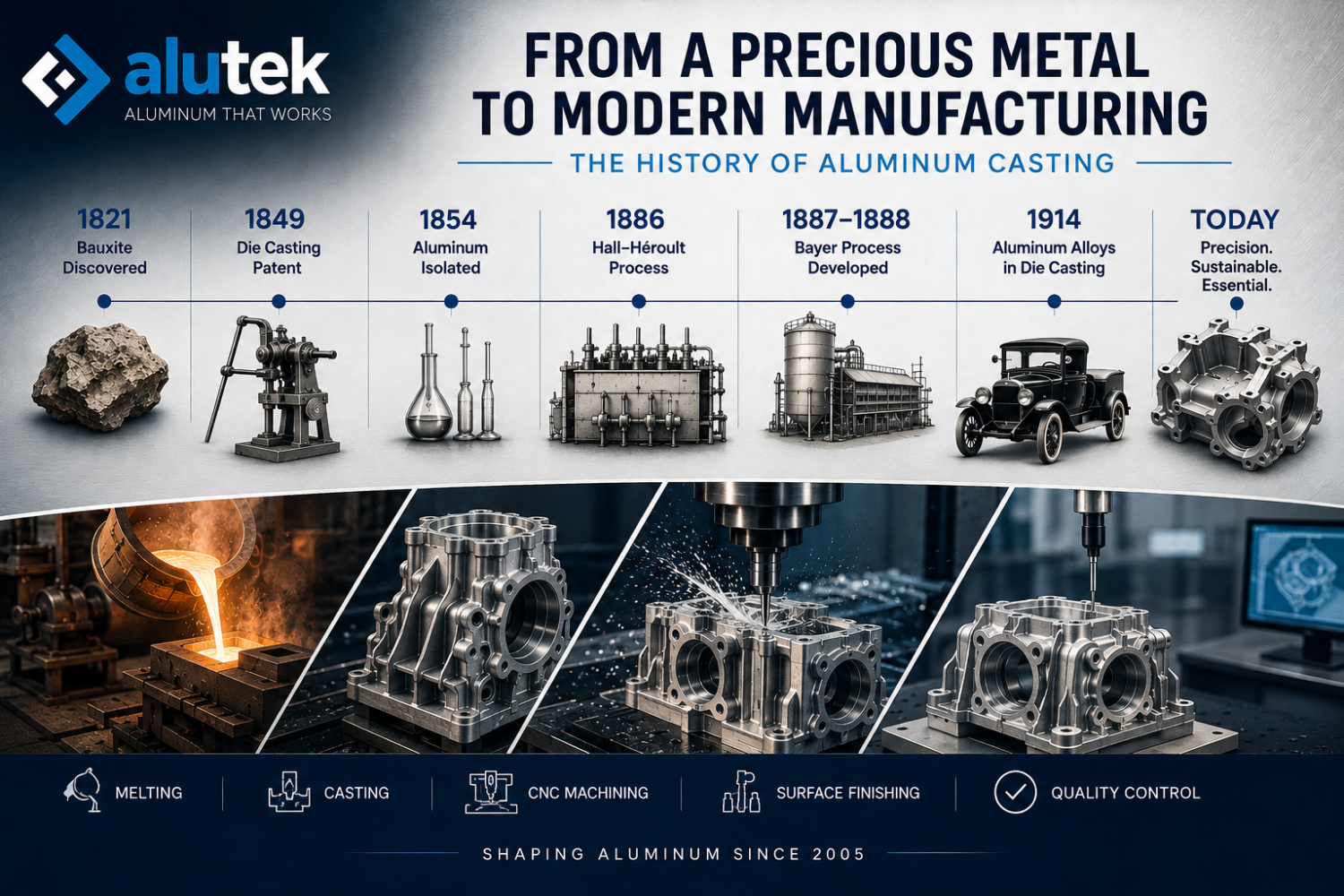
One of the most important discoveries came in 1821, when French geologist Pierre Berthier identified bauxite near Les Baux in southern France.
Bauxite would eventually become the world's principal source of aluminum.
The challenge, however, was not simply finding aluminum-bearing minerals. The real challenge was extracting the metal economically.
During the nineteenth century, several scientists developed methods for isolating aluminum. In 1854, French chemist Henri Sainte-Claire Deville developed a process capable of producing aluminum in kilogram quantities.
Production was still difficult and expensive.
As a result, aluminum remained a prestigious material rather than an everyday engineering metal.
That was about to change.
1886: The Breakthrough That Changed Aluminum Forever
One of the decisive moments in aluminum history occurred in 1886.
American Charles Martin Hall and Frenchman Paul Héroult, working independently on opposite sides of the Atlantic, developed essentially the same electrolytic method for producing aluminum.
Their discovery became known as the Hall–Héroult process.
Instead of relying on the expensive chemical extraction methods used previously, the new process used electricity to separate aluminum from alumina.
The implications were enormous.
For the first time, large-scale industrial aluminum production became economically practical.
Remarkably, the fundamental Hall–Héroult principle remains the basis of primary aluminum smelting today.
Another major development followed shortly afterwards.
Karl Josef Bayer developed the Bayer process, which provided an economical method for refining bauxite into alumina.
Together, the Bayer and Hall–Héroult processes created the industrial foundation of modern aluminum production:
Bauxite → Alumina → Aluminum
Once aluminum could be produced at industrial scale, engineers could begin exploring something equally important:
What could be manufactured from it?
From Primary Aluminum to Cast Components
Casting provided one of the answers.
The fundamental idea behind casting is remarkably simple: molten metal is introduced into a mold, where it solidifies into a predetermined geometry.
But transforming that basic principle into a repeatable industrial manufacturing process required advances in metallurgy, tooling, machinery and process control.
Aluminum proved particularly well suited to casting.
Its relatively low density, corrosion resistance, ability to form useful alloys and capacity to reproduce complex geometries opened new possibilities for engineers.
Different casting technologies evolved for different manufacturing requirements.
Sand casting offered flexibility for larger components and lower production volumes.
Permanent mold and gravity die casting provided improved repeatability and surface quality.
High-pressure die casting eventually enabled rapid production of complex components at very high volumes.
Casting was no longer simply a way to shape metal.
It was becoming an engineering discipline.
The Birth of Modern Die Casting
The history of die casting actually began before aluminum became widely available.
In 1849, Sturges received a patent for a manually operated machine that injected molten metal under pressure to manufacture printing type.
For decades, the technology remained largely associated with the printing industry.
By the end of the nineteenth century, however, its potential had expanded. By 1892, die casting was being used commercially for components found in products such as phonographs and cash registers.
Mass production followed during the early twentieth century.
Initially, die casting relied mainly on lead- and tin-based alloys.
Then came another important milestone.
Around 1914, aluminum and zinc alloys entered die casting production.
This dramatically expanded the industrial possibilities of the process.
By the 1930s, many of the alloy families that helped shape modern die casting had already emerged.
The combination of aluminum and increasingly sophisticated casting technology created a powerful manufacturing platform.
Aluminum Casting Enters the Age of Mass Production
Industrialization during the twentieth century created enormous demand for components that were lighter, stronger, repeatable and suitable for large-scale manufacturing.
Aluminum casting found applications across rapidly developing industries.
Automotive manufacturers needed lightweight housings, engine components and structural parts.
Aircraft designers sought every possible reduction in weight.
Machinery manufacturers required complex housings, covers, brackets and functional components.
Electrical and lighting manufacturers needed components capable of combining structural performance with corrosion resistance and thermal management.
Over time, aluminum castings became increasingly integrated into products rather than simply added to them.
Design engineers learned to use ribs, bosses, integrated mounting points and complex internal geometries directly within cast components.
This reduced assembly requirements and allowed several functions to be incorporated into a single part.
The casting itself was becoming more sophisticated.
But another transformation was occurring at the same time.
Precision manufacturing was beginning to redefine what happened after the metal left the mold.
From Casting to Precision Manufacturing
Modern aluminum components rarely depend on casting alone.
A casting may create the fundamental geometry of a component, but many industrial applications require additional manufacturing operations to achieve final functional requirements.
This is where casting increasingly converged with precision machining.
CNC machining allows critical surfaces, bores, threads, sealing faces and interfaces to be produced to controlled dimensional tolerances.
Surface treatments can provide additional corrosion resistance, appearance or functional properties.
Inspection technologies allow dimensional characteristics and material requirements to be verified systematically.
As manufacturing evolved, the production sequence increasingly became:
Engineering → Tooling → Casting → CNC Machining → Surface Finishing → Inspection
This changed the role of the aluminum casting supplier.
The objective was no longer simply to deliver a casting.
The objective became delivering a finished engineering component ready for integration into the customer's product or assembly.
Aluminum Casting in Modern OEM Manufacturing
For today's OEMs, the history of aluminum casting has resulted in a remarkably versatile manufacturing ecosystem.
Components can be engineered according to production volume, geometry, alloy requirements, mechanical performance, dimensional tolerances and surface expectations.
A low-volume industrial component may require a completely different manufacturing strategy from a high-volume automotive housing.
A large machinery component may favor sand or gravity casting.
A complex series-production housing may favor high-pressure die casting.
Other components may require substantial CNC machining after casting to achieve their functional interfaces.
The correct solution therefore begins long before molten aluminum reaches the mold.
It begins with understanding the component.
Technical drawings, tolerances, annual volumes, alloy specifications, surface requirements and assembly conditions all influence the manufacturing route.
This is why modern OEM sourcing increasingly involves more than selecting a casting process.
It involves building a controlled manufacturing chain from the technical drawing to the finished component.
More Than a Century of Continuous Development
Modern casting plants would be almost unrecognizable to the pioneers of the nineteenth century.
Simulation software can help engineers analyze mold filling and solidification before tooling enters production.
CNC machining centers can create precision interfaces after casting.
Coordinate measuring systems can verify complex geometries.
Automated production equipment can improve repeatability across thousands of components.
Material analysis and process control can provide levels of traceability that early metalworkers could never have imagined.
Yet the fundamental principle remains familiar:
Molten aluminum is shaped into a useful form.
What has changed is the level of engineering control surrounding that transformation.
The Next Chapter of Aluminum Casting
The evolution of aluminum casting is continuing.
OEM manufacturers are increasingly focused on reducing component weight, consolidating assemblies, improving production efficiency and managing the environmental impact of their supply chains.
Aluminum is particularly relevant to this transition because it combines engineering performance with significant recycling potential.
At the same time, casting technology continues to develop through improved simulation, automation, process monitoring, tooling technology and increasingly integrated manufacturing systems.
The future of aluminum casting will therefore not be defined by casting alone.
It will be shaped by the integration of materials science, casting engineering, machining, automation, quality control and intelligent manufacturing.
From Molten Metal to Modern Engineering
The history of aluminum casting is ultimately a story of transformation.
A metal that was once extraordinarily difficult and expensive to produce became one of the fundamental engineering materials of the industrial world.
The Hall–Héroult process made large-scale aluminum production possible.
Advances in casting made complex shapes repeatable.
Modern machining brought precision.
Quality systems brought control.
And generations of engineering development transformed the simple act of pouring molten metal into a mold into a sophisticated manufacturing chain.
Today, an aluminum component may begin as a technical drawing and pass through alloy selection, tooling, casting, CNC machining, surface finishing and dimensional inspection before reaching an OEM production line.
The technology has changed enormously.
The objective remains remarkably consistent:
to transform aluminum into a component that performs exactly as engineering requires.
At Alutekworks, this evolution is reflected in the way we approach modern OEM manufacturing — combining aluminum casting, CNC machining, surface finishing and quality control to manufacture components according to customer drawings and technical requirements.
Because after nearly two centuries of industrial development, aluminum casting is no longer simply about shaping metal.
It is about shaping engineering possibilities.