
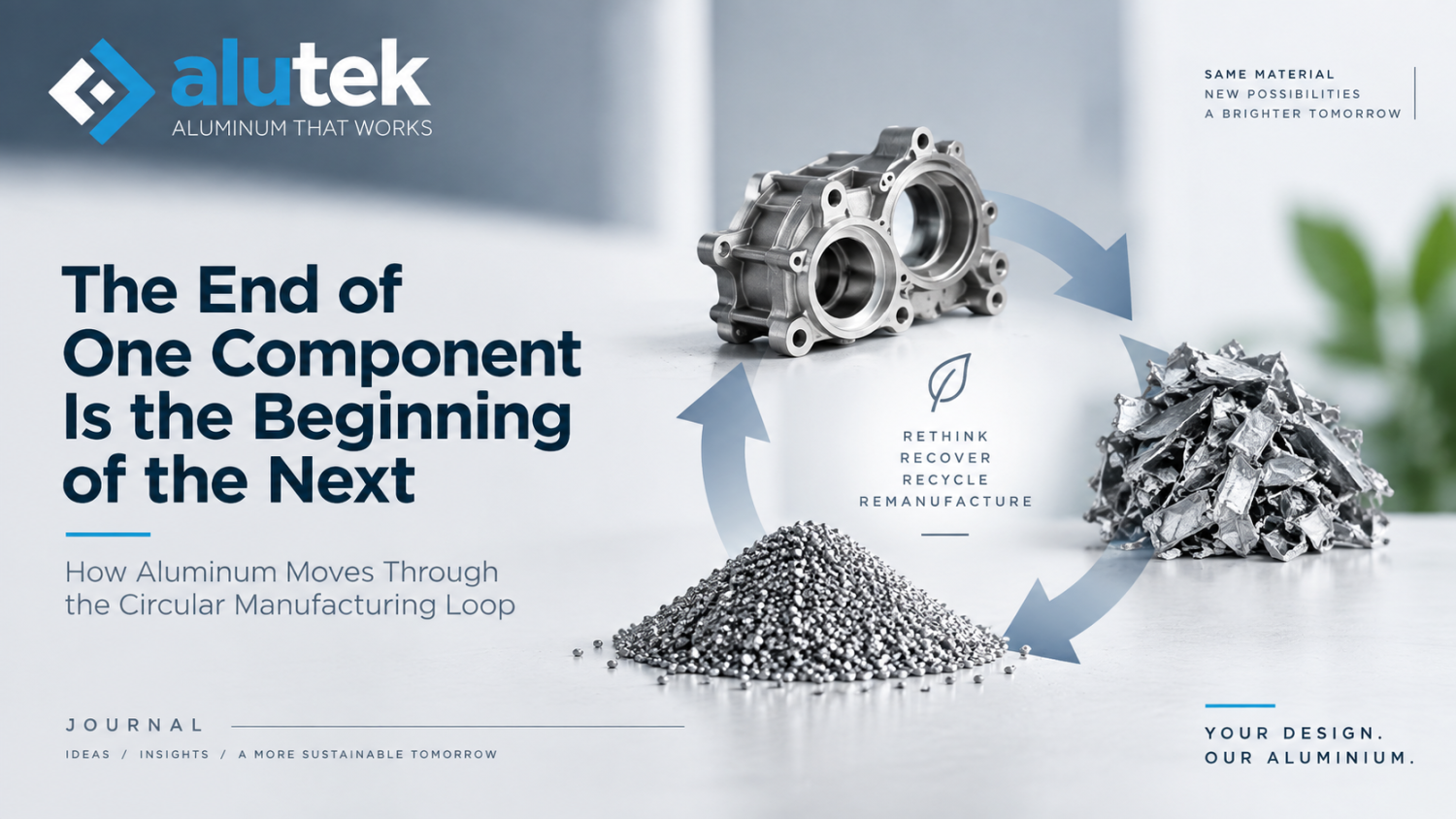
The End of One Component Is the Beginning of the Next
How Aluminum Moves Through the Circular Manufacturing Loop
In our previous Journal article, we concluded with one central idea:
For aluminum, the end of one component can become the beginning of the next.
But what actually has to happen for that to become true?
When an aluminum component reaches the end of its service life, is simply remelting it enough? Can the aluminum from an industrial housing that has operated for twenty years become raw material for another precision OEM component? How is alloy integrity maintained? What happens to paint, steel inserts, oils, different alloys and other contaminants?
These questions take us far beyond the simple statement that “aluminum is recyclable.”
Because true circular manufacturing is not simply about recycling.
It is about returning material to the manufacturing system while preserving as much of its engineering value as possible.
The Component Reaches the End of Its Life. The Material May Continue.
Consider a cast aluminum housing that has operated inside an industrial machine for twenty years.
Over time, the component may reach the end of its technical or economic service life. The machine may be replaced, the product design may change or the equipment may be taken out of service completely.
For the component, this may represent End-of-Life. But the same does not necessarily have to be true for the aluminum contained within it.
We therefore need to distinguish between two different lifecycles:
Component Life → Ends
Material Life → May Continue
This distinction lies at the heart of circular manufacturing.
The fact that a component can no longer perform its original function does not mean that the metal within it has lost its industrial value. But preserving that value requires something that comes even before recycling.
Recovery Comes Before Recycling
The fact that a material is theoretically recyclable does not mean that it will actually be recycled.
First, the material must be recovered at the end of its service life.
A simplified chain looks like this:
Product → Collection → Disassembly → Material Recovery → Sorting → Recycling
If an aluminum component cannot be economically collected at the end of its service life, cannot be separated from other materials or enters a mixed waste stream, the practical value of its theoretical recyclability may decrease.
This means two concepts should not be confused:
Recyclability ≠ Actual Recycling Rate
Recyclability describes the technical ability of a material to be processed and used again.
The recycling rate describes how much of that material is actually collected and returned to the production system in the real world.
Both matter in a circular industrial system.
Not All Aluminum Is the Same Aluminum
Once a recovered component begins its journey back into the material cycle, another critical stage begins:
Sorting.
From a metallurgical perspective, it is not sufficient to treat aluminum scrap simply as “aluminum.”
Industry uses many different aluminum alloys, each with a different chemical composition.
Casting alloys, for example, may contain different levels of:
· silicon (Si)
· magnesium (Mg)
· copper (Cu)
· iron (Fe)
· zinc (Zn)
· and other elements
Likewise, wrought 5xxx or 6xxx series alloys used in sheet, forged or extruded products do not have the same chemical composition as casting alloys.
Uncontrolled mixing of different aluminum scrap streams can therefore alter the chemistry of the resulting metal.
This leads to an important principle:
The value of aluminum scrap depends not only on how much aluminum it contains, but also on how well its alloy identity can be preserved.
This brings us to two important concepts in circular manufacturing.
The Difference Between Closed-Loop and Open-Loop Recycling
Not every recycling route creates the same material loop.
Closed-Loop Recycling
In a closed-loop system, the material returns to the same or a technically similar level of application.
In simplified form:
Alloy A → Use → Scrap → Sorting → Reprocessing → Alloy A or Equivalent Application
The objective is to preserve not only the mass of the metal, but also as much of its material value as possible.
Open-Loop Recycling
In an open-loop system, the recovered material may move into a different product or alloy system:
Application A → Scrap → Recycling → Application B
This is still recycling and can provide significant material recovery.
But the important distinction is:
Recycling does not automatically mean closed-loop recycling.
The quality of circularity is therefore not determined only by how many kilograms of metal are recycled, but also by the technical value at which the recovered material can be used again.
Contamination: The Hidden Challenge in the Loop
An OEM component that has reached the end of its service life often consists of more than aluminum alone.
It may contain or carry:
· steel inserts
· fasteners
· bearings
· plastic components
· seals
· oils and greases
· paint
· powder coating
· other surface coatings
· adhesives or sealing compounds
Some of these materials may need to be separated before the aluminum enters the recycling process. Otherwise, foreign materials can affect metal quality, melting efficiency or subsequent processing.
This is where the concept of Design for Disassembly, discussed in our previous Journal article, becomes relevant again.
The fastening method, insert design and material combinations selected when a component is designed today can influence how easily it can be separated twenty years later.
Recycling, therefore, is not an activity that begins only at the end of a product's life.
The ability to recycle a component can begin to be influenced during the design stage.
Remelting Is Not a “Reset” Button
The scrap has now been properly collected, sorted and prepared for melting.
Is melting the metal all that remains?
No.
Remelting does not automatically erase the metal's history.
Several variables must be controlled during melting:
· oxidation
· dross formation
· metal loss
· hydrogen control
· inclusions
· melting temperature
· chemical composition
Not all metal entering a melting operation is converted perfectly into usable molten aluminum. Oxidation and process losses can occur.
At the same time, combining different scrap sources can alter the chemical composition of the molten metal.
Therefore, there is no automatic transformation of:
Scrap → Furnace → Perfect New Aluminum
Between those stages lie metallurgy and process control.
Chemistry Must Be Brought Back Under Control
This is where one of the most critical stages for precision OEM manufacturing begins.
The chemical composition of the molten metal must meet the specification of the target alloy.
If a particular Al-Si-Mg alloy is required, for example, silicon, magnesium, iron, copper and other elements must remain within acceptable limits.
In a recycled metal mixture, some elements may fall outside the target range.
The manufacturer therefore cannot simply say:
“This metal is recycled.”
The more important question is:
“Does this metal meet the required alloy specification?”
Chemical analysis plays a critical role here.
Where necessary, alloy chemistry can be adjusted, and recycled metal may be used together with suitable primary aluminum or other controlled metal inputs to achieve the required specification.
This reveals an important reality about circular manufacturing:
Circular manufacturing does not necessarily mean eliminating primary aluminum completely.
A more realistic objective is:
To preserve as much value as possible from existing metal while using primary material intelligently and in a controlled manner where necessary.
The Metal Becomes a Component Again
Once its chemistry has been controlled, the molten aluminum is ready to re-enter the manufacturing system.
At this point, the circular journey reconnects with the manufacturing process we explored earlier in our Journal series:
Controlled Alloy → Casting → Solidification → CNC Machining → Surface Finishing → Quality Control → New OEM Component
Aluminum that once performed a function inside another machine can now become part of the raw material for a new component.
The component has changed. The metal has returned to the manufacturing cycle.
But from an OEM manufacturing perspective, this raises another important question.
Can the New Component Really Deliver Equivalent Performance?
The fact that a component contains recycled aluminum is not sufficient on its own.
For an OEM, what matters is whether the finished component meets its technical requirements.
The questions remain the same:
· Are the mechanical properties suitable?
· Does the chemical composition meet specification?
· Is porosity within acceptable limits?
· Can the component be machined consistently?
· Is dimensional stability sufficient?
· Is the surface quality appropriate?
· Does it provide the required corrosion performance?
· Are the material and process traceable?
Therefore:
Recycled content has value only when it is accompanied by controlled material properties and verified component performance.
The tolerances, material specification or functional requirements of an OEM drawing do not change simply because recycled material is being used.
A specification remains a specification.
And this brings us directly to the next technical question in our Journal series.
Think Beyond Recycling Rate: Think About Material Value
Circular manufacturing is often discussed in kilograms.
How much scrap did we collect? How much did we recycle?
These are important questions. But from an engineering perspective, we can ask another:
How Much Engineering Value Did the Recycled Material Retain?
Sending high-quality, identified alloy scrap into a mixed scrap stream and using the resulting metal in a lower-demand application is still recycling.
But preserving the alloy identity and returning the same metal to a high-value engineering application represents a different level of circularity.
We can consider this through the concept of Material Value Retention.
The objective is not only to prevent metal from becoming waste.
Where possible, the aim is to preserve:
Metal + Alloy Identity + Technical Value
together.
This may become increasingly important for advanced metal recycling systems of the future.
Today's Engineering Drawing Can Influence Tomorrow's Scrap Quality
One of the most interesting aspects of the circular loop takes us back to the design table.
Engineering decisions made today concerning:
· alloy selection
· insert design
· fasteners
· coating systems
· material combinations
· disassembly
can influence the quality of material recovery years later.
For example, a steel insert that can be easily removed does not create the same recycling scenario as a metal combination that cannot be economically separated from the aluminum.
Likewise, an identifiable alloy component may retain a different material value from mixed scrap whose origin and chemistry are unknown.
This creates an important connection:
Today's engineering drawing can influence tomorrow's scrap quality.
Design for Manufacturing may therefore no longer be sufficient as the only design framework.
Future engineering may increasingly need to consider:
Design for Manufacturing + Design for Disassembly + Design for Recycling
together.
Where Does the Loop Actually Close?
The loop does not close when the scrap reaches the recycling facility. Nor does it close when the metal is melted.
The loop becomes meaningful only when the recovered material is transformed once again into a functional and reliable industrial product.
The complete journey is therefore:
Component → Use → Recovery → Sorting → Preparation → Remelting → Chemical Control → Alloy Adjustment → Casting → CNC Machining → Quality Control → New Component
Every link in this chain matters.
Poor sorting affects metallurgy. Uncontrolled melting affects metal quality. Incorrect alloy chemistry affects the performance of the new component. Insufficient quality control can undermine confidence in the entire loop.
Circular manufacturing, therefore, is not merely an environmental concept.
It is also a challenge involving:
Materials Engineering + Manufacturing Engineering + Quality Control + Supply Chain
The Component Changes. The Aluminum Continues.
An aluminum component has a defined function and a defined service life.
It may be a machinery housing. A lighting component. A railway part. An automotive component.
Eventually, that function comes to an end.
But with proper recovery, sorting, metallurgical control and manufacturing processes, the aluminum within it can once again become an economically valuable industrial resource.
The new alloy is controlled. A new component is cast. Critical surfaces are CNC machined. The component is inspected. And the metal begins working again inside a new product.
This leads to one of the most fundamental distinctions in circular manufacturing:
A component has a service life.
Aluminum has a material life.
Circular manufacturing connects the two.
And so we return to where we began:
The end of one component can become the beginning of the next.
But this leaves us with a new and much more technical question:
When recycled aluminum returns to precision OEM manufacturing, how can we ensure that its alloy chemistry, mechanical properties and component performance still meet the requirements of the technical drawing?
That is the question we will address in the next chapter of our Journal series:
Recycled Aluminum in Precision OEM Components: What Really Matters?