
Why Is Aluminium Important to the Future of Low-Carbon Industry?
Recycling, Carbon Footprint and the Changing Economics of OEM Manufacturing
Aluminium is often described as a lightweight, corrosion-resistant and recyclable material. These are all important properties. However, aluminium’s true strategic value for the industry of the future does not lie in any one of these properties alone.
Its true value lies in aluminium’s ability to retain its value as an industrial resource even after a product reaches the end of its service life.
This distinction matters. Primary aluminium production is an energy-intensive process. Therefore, simply making a part from aluminium does not automatically make it “low-carbon” or “sustainable”.
The real question is:
How much energy did we use to produce one kilogram of material, how efficiently did we turn that material into a component, how long did the component perform its function, and how much of the metal did we return to the production cycle at the end of its service life?
This is precisely where the property that makes aluminium one of the industrial materials of the future comes into play.
Aluminium Has a Carbon Problem — But Also a Major Circularity Advantage
Primary aluminium production involves an energy-intensive supply chain that starts with ore and progresses through alumina to metallic aluminium. As a result, the carbon footprint of primary aluminium can reach significant levels, depending on the electricity source and production technology used.
Data from the International Aluminium Institute show a very large difference between the carbon intensity of global primary aluminium production and that of recycled metal production.
The main reason for this is the energy requirement.
According to IAI data, producing one tonne of primary aluminium requires approximately 186 GJ of energy globally, while the corresponding figure for one tonne of recycled aluminium is approximately 8.3 GJ.
In other words, recycling aluminium can require approximately 95% less energy than primary production.
However, an important engineering distinction must be made here: energy consumption and carbon footprint are not the same thing. The source of electricity, scrap preparation, transport, melting technology, metal losses and the life-cycle boundaries used all affect the final carbon calculation.
Therefore:
Saying “Aluminium is recyclable, so it is low-carbon” is an incomplete approach.
A more accurate statement is:
Aluminium’s low-carbon potential depends on how the material is produced and how its life cycle is managed.
A Component’s Life May End; Aluminium’s Life as a Material Does Not Have to
In the traditional linear manufacturing model, a material’s journey is quite simple:
Raw Material → Production → Product → Use → Waste
In circular manufacturing, the final link in this chain changes:
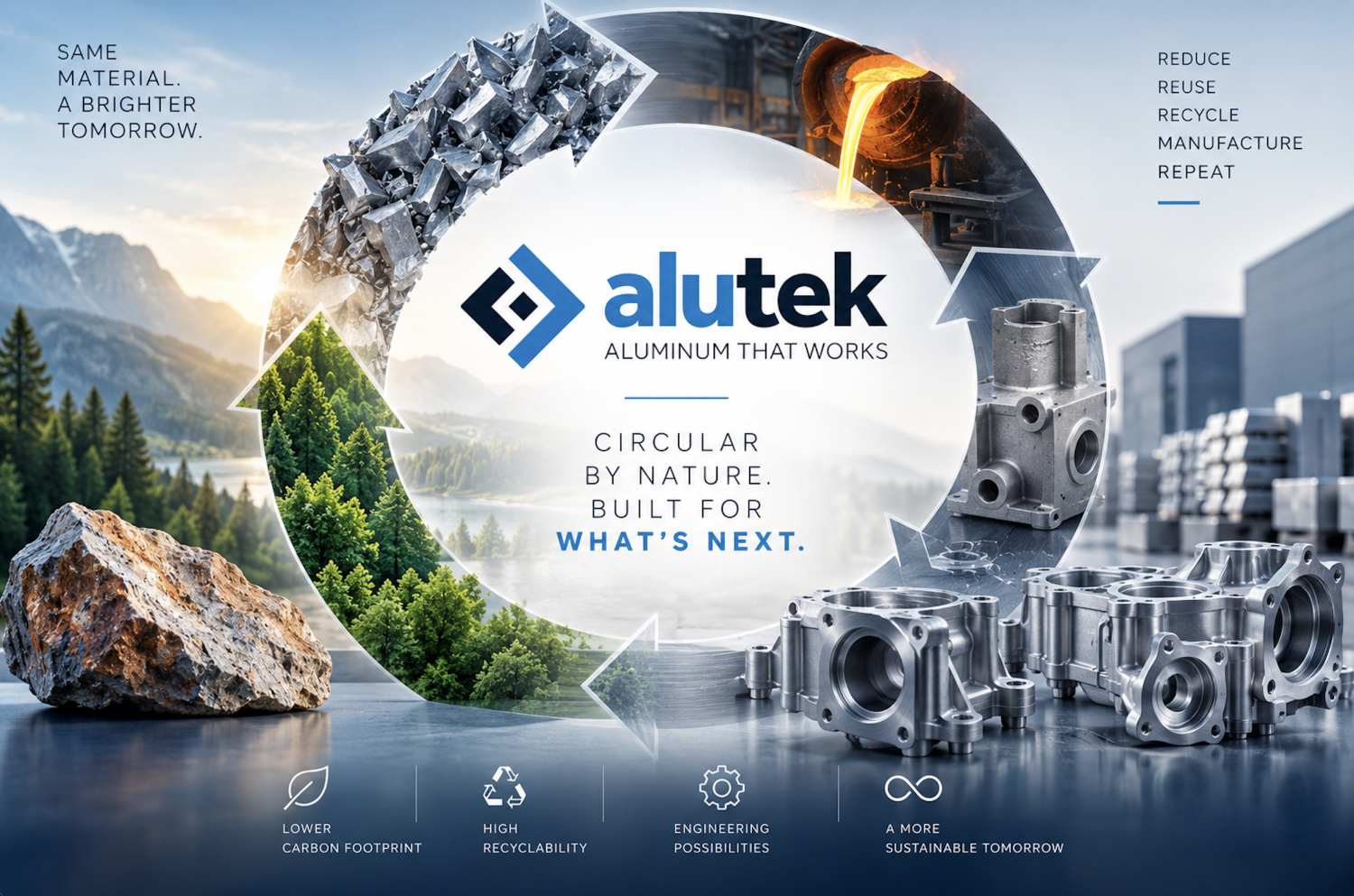
Raw Material → Component → Use → Recovery → Sorting → Remelting → Secondary Aluminium → New Component
This seemingly small change actually transforms the way industry views materials.
An aluminium housing, machine component, lighting part or railway component may reach the end of a twenty- or thirty-year service life.
However, this does not mean that the aluminium it contains has lost its economic value.
The International Aluminium Institute’s estimates of long-term material stocks show that a very large proportion of all aluminium ever produced is still in use.
We can therefore make an important distinction for aluminium:
A component may reach the end of its service life, while the aluminium within it can continue its life as a material.
This property will become increasingly valuable in the circular industrial model of the future.
Scrap Is Not the End of Production
Let us consider the production process for an aluminium component.
Gating systems and process scrap may arise during casting. Parts that do not meet quality requirements may be segregated. CNC machining generates chips. At the end of the product’s service life, the component itself becomes scrap.
Viewing all of these simply as “waste” means overlooking a significant part of the material’s industrial value.
A different approach is possible in circular manufacturing:
Casting → Machining → Use → Recovery → Remelting → New Metal → New Component
For this reason, managing scrap in future production systems will not merely be a waste management issue.
It will also be a matter of raw material management.
Because in circular manufacturing, scrap is not always the end of the process.
It can be the raw material for the next production cycle.
But Recycling Is More Than “Melting It Again”
Aluminium’s recyclability is an important advantage. However, actual industrial recycling is not as simple as putting scrap into a furnace and melting it again.
Many variables must be controlled to achieve a high-quality material cycle:
- correct alloy identification,
- sorting different scrap streams,
- controlling contamination by foreign materials,
- accounting for coatings and surface treatments,
- proper melting practices,
- reducing metal losses,
- controlling chemical composition.
For example, uncontrolled mixing of different alloys can affect the chemical composition of the resulting secondary metal and make it more difficult to use in new applications that require high performance.
It is therefore necessary to distinguish between two concepts:
Recyclability is a material property. Circularity is a production system.
Aluminium may be recyclable. But creating a truly high-value cycle requires design, production, scrap sorting, metallurgy and quality control processes to work together.
CNC Chips Are More Than Waste: They Are a Material Stream
This is particularly important in OEM manufacturing where casting and CNC machining are carried out together.
When a cast component is CNC-machined, a certain amount of metal is removed from the part. In traditional costing, these chips are often treated merely as production loss.
However, with proper alloy segregation, collection, storage and contamination control, aluminium chips can become a secondary raw material stream with economic value.
This brings us to an important manufacturing concept:
Material Yield
The performance of a production process should not be assessed solely by the number of components it produces.
The following question should also be asked:
How much of the metal entering production becomes a usable finished component?
For example, using 10 kg of metal to produce a 6 kg finished component and delivering the same function with a higher material yield do not represent the same production performance.
For this reason, low-carbon manufacturing is not just about energy consumption.
How efficiently we use the material matters too.
Lightweighting: The Advantage Goes Beyond the Weight of the Part
Aluminium’s density is approximately one-third that of steel. This makes it extremely important in engineering applications that require low weight.
However, the effect of lightweighting is not limited to the difference in kilograms when a component is placed on a scale.
Depending on the application, a lower component weight can create the following chain:
Lighter Component → Lighter System → Easier Transport and Assembly → Lower Mass Carried → Potential Energy Advantage During Use
This effect can be particularly important in automotive, railway, material handling systems and moving machinery applications.
Here, too, simplistic generalisations must be avoided.
Replacing a steel component with aluminium does not automatically reduce the carbon footprint.
An aluminium design may require different cross-sections to achieve the same stiffness or strength. The alloy used, production method, component life, maintenance requirements, energy source and end-of-life recycling scenario can all change the outcome.
Therefore:
Material substitution alone does not constitute sustainability. The entire life cycle must make sense from both an engineering and an environmental perspective.
Designing for the Future: Not Only for Manufacturing, but Also for Recycling
Today, Design for Manufacturing — DFM — is an important concept in OEM engineering.
But other concepts will increasingly enter the engineering equation of the future:
Design for Disassembly
Design for Recycling
Material Traceability
Because the efficiency with which a component can be recycled years later may be influenced by design decisions made today.
For example:
- can different metals be separated easily?
- can steel inserts be removed?
- can the alloy used be identified?
- does the surface coating affect the subsequent recycling process?
- can the component be easily disassembled at the end of the product’s life?
- can different aluminium alloys be sorted without becoming mixed?
These questions may not appear on every engineering drawing today.
However, their importance will grow as circular industry develops.
Because:
The recyclability of tomorrow’s component can be influenced by today’s engineering decisions.
Carbon Is Becoming a Procurement Parameter
For many years, the traditional OEM procurement model revolved around three key variables:
Quality + Cost + Delivery
Quality, price and delivery.
These three criteria will remain important in the future. But the equation is expanding:
Quality + Cost + Delivery + Carbon + Recycled Content + Traceability
One important reason is that companies increasingly want to measure not only direct emissions from their own facilities, but also indirect emissions arising from their supply chains.
Under the GHG Protocol, upstream emissions from purchased goods and services can be accounted for within Scope 3.
This may change the questions an OEM procurement department asks its suppliers.
The traditional question:
“What is the price of this component?”
Increasingly, the new questions may also include:
“What is the component’s product carbon footprint?”
“What is the material’s recycled content?”
“Can the origin of the material be traced?”
“Can the supplier provide data on production emissions?”
At this point, carbon ceases to be solely the concern of the sustainability department.
It becomes part of engineering, procurement and supply chain decisions.
Europe Is Bringing Carbon into the Commercial Equation
This transformation is particularly important for European industry.
The definitive phase of the European Union’s Carbon Border Adjustment Mechanism — CBAM — began on 1 January 2026, and aluminium is one of the main sectors covered by the mechanism.
However, there is an important distinction here:
Not every aluminium component is automatically covered by CBAM.
The product’s classification, CN code and the scope of the relevant legislation are decisive.
Nevertheless, the broader industrial signal sent by CBAM is clear:
Carbon data are moving from environmental reporting into commercial supply chain decisions.
This change is particularly important for suppliers operating in countries such as Türkiye that are strongly integrated into European production chains.
The competitive advantage of the future may not be limited to producing the right part at the right price.
A manufacturer’s ability to understand its materials, processes and the associated environmental data may also become increasingly valuable.
From Price per Kilogram to Carbon per Component
Industry has long assessed metals by the kilogram:
€/kg
In OEM manufacturing, the more meaningful commercial measure:
€/component
became the norm.
We can now expect a third measure to be added alongside these increasingly often:
kg CO₂e/component
This change broadens the way production performance is assessed.
Traditional Production Metric | Emerging Production Metric |
€/kg | kg CO₂e/kg material |
€/component | kg CO₂e/component |
Tooling cost | Tool life and total production volume |
Scrap rate | Material recovery |
Lead time | Supply chain traceability |
Quality | Quality + environmental data |
Annual production quantity | Total life-cycle material flow |
These new metrics do not have to replace traditional production criteria.
They complement them.
Because the OEM of the future will still want components that are high-quality, cost-effective and delivered on time.
However, knowing which material, energy source and production route were used to manufacture that same component, and with what carbon burden, may become increasingly important.
The Lowest-Carbon Component Is Not Always the Lightest
Another important misconception emerges here.
Consider two components:
Component A: 4.0 kg
Component B: 4.5 kg
Looking only at weight, Component A might appear to be environmentally preferable.
However, the result may change if Component B uses a higher recycled content, requires less CNC machining, achieves a higher material yield, generates less production loss and has a longer service life.
Therefore, looking only at component weight or the carbon value per kilogram of the material used is not always sufficient.
A useful framework for thinking about this is:
Functional Carbon Efficiency
In other words:
How much functional performance and service life do we obtain in return for the carbon invested in producing a component?
This is not an officially standardised LCA metric. However, it is a useful way of thinking when evaluating engineering decisions.
Because the purpose of low-carbon engineering is not simply to use less material.
The aim is:
To deliver the required function, quality and service life with the most efficient use of resources possible.
The Engineering Drawing of the Future May Define More Than Dimensions
Today, an OEM engineering drawing typically defines:
Geometry → Dimensions → Tolerances → Material → GD&T → Surface Requirements
However, in future RFQs and technical specifications, we may encounter additional requirements alongside these more frequently:
Recycled Content Requirement
Product Carbon Footprint Data
Material Traceability
Supplier Environmental Data
End-of-Life Requirements
This change will also transform the manufacturer’s role.
The manufacturer will no longer merely turn the geometry on an engineering drawing into a physical part.
It will need to become a manufacturing partner capable of providing information on material selection, process efficiency, production data and the component’s life cycle.
In short:
The engineering drawing defines the component. The RFQ of the future may increasingly define the component’s environmental performance as well.
Viewing Aluminium as an Industrial Resource, Not a Consumable
Explaining aluminium’s advantage in the industry of the future simply as “lightweight and recyclable” would underestimate the material’s true potential.
Aluminium:
- is lightweight,
- is corrosion-resistant,
- can be cast into different geometries,
- can be precision CNC-machined,
- is suitable for various surface treatments,
- can be recovered at the end of its service life,
- and can be turned back into an industrial raw material under appropriate metallurgical control.
Its true strategic value lies in the combination of these properties in a single material.
The low-carbon industry of the future will not be defined solely by how quickly and economically we produce components.
It will also be defined by how intelligently we keep the materials we use within the production cycle.
Seen from this perspective, aluminium is more than one of today’s manufacturing materials.
As circular manufacturing systems develop, it is a strong candidate to become one of the industrial resources of the future.
Because for aluminium:
The end of one component can be the beginning of the next.