
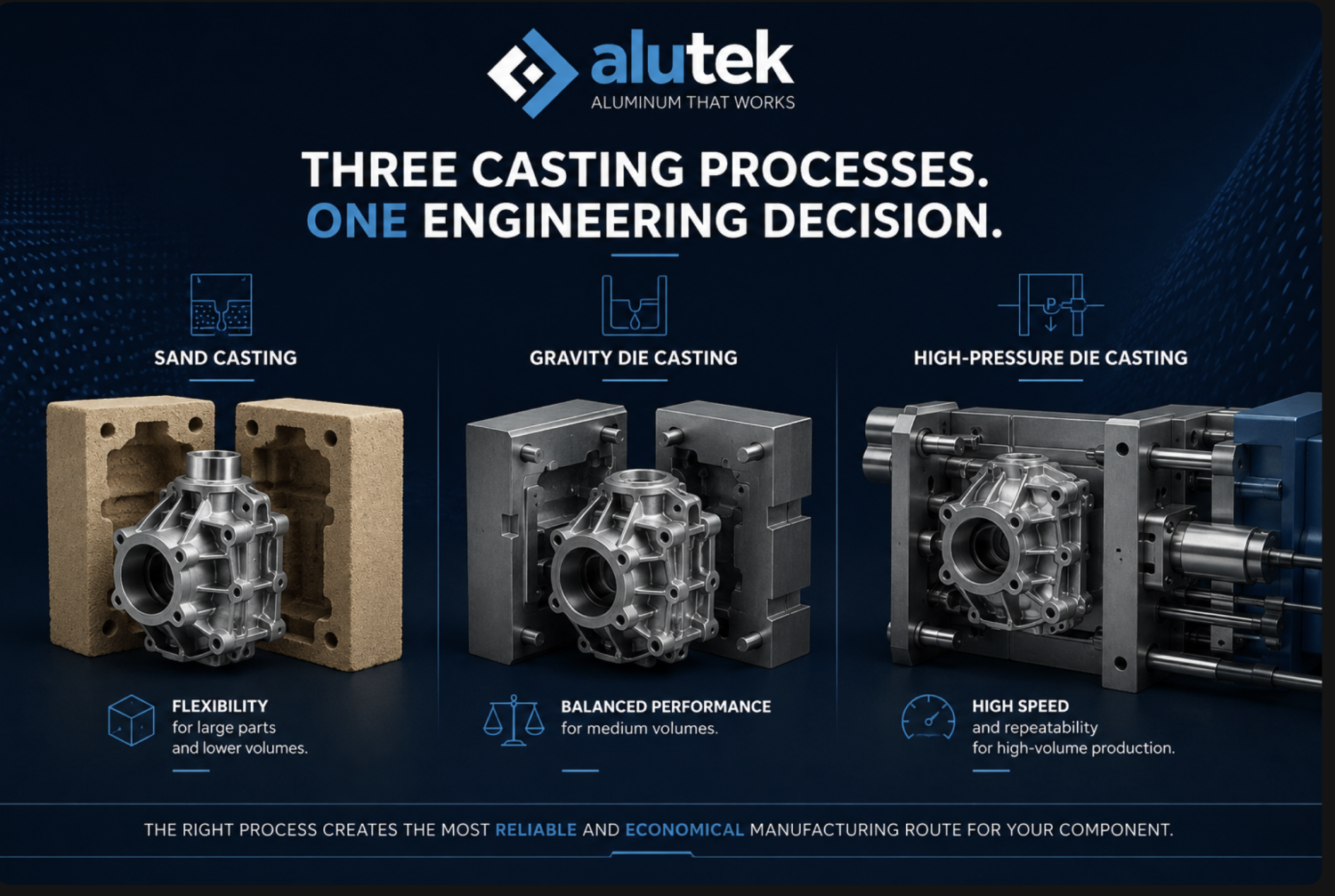
Sand Casting vs Gravity Die Casting vs High-Pressure Die Casting: Which Process Is Right for Your Component?
Choosing an aluminum casting process is not simply a question of selecting the most advanced technology.
Sand casting, gravity die casting and high-pressure die casting can all produce reliable aluminum components, but they are designed around different manufacturing conditions. Component size, geometry, annual production volume, tooling investment, dimensional requirements, surface expectations, mechanical performance and downstream machining can all influence which process makes the most sense.
There is therefore no universally “best” aluminum casting process.
The right process is the one that creates the most reliable and economical manufacturing route for the specific component.
In our previous Journal article, we followed the aluminum casting process from technical drawing and process engineering through casting, CNC machining, finishing and quality control. The next question is equally important:
Which casting method should be used in the first place?
Why Casting Process Selection Matters
The casting method affects much more than how molten aluminum enters a mold.
It can influence:
• initial tooling investment
• achievable geometry and wall thickness
• dimensional repeatability
• surface condition
• production cycle time
• machining requirements
• production capacity
• ultimately, the total cost of the finished component
This is why process selection should ideally begin during the engineering stage rather than after the component design has already been finalized.
A technically feasible process is not necessarily the most economical one. Likewise, the process with the lowest tooling cost does not necessarily produce the lowest total component cost.
Understanding this distinction is fundamental to OEM manufacturing.
1. Sand Casting
Sand casting is one of the oldest and most versatile metal casting technologies, yet it remains highly relevant in modern industrial manufacturing.
In this process, a mold cavity representing the component geometry is formed in specially prepared molding sand. Molten aluminum is introduced into the cavity and allowed to solidify. The sand mold is then broken apart to remove the casting.
For this reason, sand casting belongs to the category of expendable-mold casting processes.
Unlike permanent metallic molds, the sand mold normally serves a single casting cycle.
Where Sand Casting Becomes Attractive
One of the principal advantages of sand casting is its flexibility.
It can be particularly useful for:
• large aluminum components
• low and medium production volumes
• prototypes and early production stages
• components with complex internal cavities
• products requiring extensive use of cores
• projects where high initial tooling investment would be difficult to justify
Sand casting also provides significant flexibility regarding component size.
For large machinery housings, structural components or industrial castings, this can make it an important manufacturing option.
The Trade-Off
That flexibility comes with compromises.
Compared with metallic-mold processes, sand casting generally provides a rougher as-cast surface and broader dimensional tolerances. Production cycles are also slower, and certain functional areas may require additional CNC machining.
This does not make sand casting an inferior technology.
It simply means that its strengths lie in a different manufacturing window.
For a large industrial housing produced in relatively low annual quantities, for example, investing in an expensive permanent die may provide little economic advantage.
In that situation, sand casting may be the more intelligent engineering choice.
2. Gravity Die Casting
Gravity die casting, also known as permanent mold casting, introduces a fundamentally different manufacturing concept.
Instead of an expendable sand mold, the process uses a reusable metallic die.
Molten aluminum fills the mold primarily under the force of gravity rather than being injected at the very high pressures associated with high-pressure die casting.
The metallic tooling provides greater consistency from one casting cycle to the next.
As a result, gravity die casting can offer an attractive combination of:
• repeatability
• surface quality
• dimensional control
• mechanical performance
• production efficiency
Why Gravity Die Casting Occupies an Important Middle Ground
Gravity die casting often sits between sand casting and high-pressure die casting in terms of manufacturing economics and production volume.
For many industrial OEM applications, that middle ground is extremely valuable.
The process can be suitable where production quantities justify investment in reusable tooling but do not necessarily require the very high production rates associated with HPDC.
Applications may include industrial housings, machinery components, automotive parts, lighting components and other engineered aluminum products.
Gravity die casting can also be combined with cores when internal geometry requires them, although tooling and core strategy must be considered during process engineering.
Better Casting Does Not Mean Zero Machining
A common misconception is that improved dimensional repeatability eliminates the need for machining.
It does not.
Consider a cast housing containing:
• precision bearing seats
• threaded holes
• sealing faces
• shaft bores
• mounting interfaces
• tightly controlled datums
These features may still require CNC machining regardless of how consistent the casting process is.
This is why casting and machining should be considered as one manufacturing system, rather than two unrelated operations.
3. High-Pressure Die Casting
High-pressure die casting — commonly abbreviated as HPDC — is designed around speed, repeatability and high-volume production.
In HPDC, molten metal is introduced into a steel die at high velocity and pressure.
This allows the process to produce complex geometries, relatively thin wall sections and highly repeatable components with short production cycles.
HPDC is therefore widely associated with high-volume industries.
Its strengths can include:
• rapid cycle times
• excellent production repeatability
• thin-wall capability
• complex geometry
• good as-cast surface quality
• high production output
However, these benefits come with an important economic consideration:
Tooling investment.
HPDC tooling and the associated production system can require significantly greater initial investment than simpler casting routes.
For very high production volumes, that investment can be distributed across a large number of components.
For low production volumes, the same investment may be difficult to justify.
This is one reason why selecting a casting process purely according to its technical capabilities can lead to poor manufacturing economics.
Sand Casting vs Gravity Die Casting vs HPDC
The differences become clearer when the processes are considered side by side.
Decision Factor | Sand Casting | Gravity Die Casting | High-Pressure Die Casting
Initial tooling investment | Lower | Medium | Higher
Typical production logic | Low–Medium volume | Medium volume | High volume
Large component flexibility | Very good | Application dependent | Application dependent
Thin-wall capability | Limited | Moderate | Very good
As-cast surface quality | Moderate | Good | Very good
Dimensional repeatability | Moderate | Good | Very good
Production cycle | Relatively slow | Medium | Fast
Mold principle | Expendable | Reusable | Reusable
Complex internal cavities | Strong with cores | Possible with appropriate core strategy | Geometry/process dependent
CNC machining | Application dependent | Application dependent | Application dependent
This comparison should not be interpreted as an automatic process-selection formula.
A real component may contain characteristics that shift the decision significantly.
Wall thickness, alloy, internal geometry, structural requirements, porosity limitations, heat treatment, surface treatment and machining can all change the optimum manufacturing route.
Production Volume Changes the Economics
One of the most important — and sometimes underestimated — variables is production volume.
Consider a simplified example.
Suppose a manufacturing process requires €40,000 of dedicated tooling.
If the tooling supports a production program of 100,000 components, its simplified allocation is:
€40,000 ÷ 100,000 = €0.40 per component
If the same tooling investment is used for only 1,000 components:
€40,000 ÷ 1,000 = €40 per component
The difference is enormous.
Of course, real tooling economics are more complex. Tool life, maintenance, cavities, production rates, project duration and expected lifetime volume must also be considered.
But the principle remains important:
Tooling cost should be evaluated against the expected production program, not in isolation.
This is particularly relevant to OEM procurement.
The lowest piece price does not automatically represent the lowest overall manufacturing cost if achieving that price requires an inappropriate level of capital investment.
Three Different Components, Three Different Decisions
Scenario A — Large Machinery Housing
Imagine a relatively large aluminum machinery housing with substantial wall sections and an annual requirement of only a few hundred pieces.
The component requires several machined interfaces, but extremely fast casting cycles are not important.
In such a case, sand casting may deserve serious consideration.
Its lower tooling threshold and flexibility for large components may outweigh the benefits of a higher-speed permanent-mold process.
Scenario B — Medium-Volume Industrial Component
Now consider an industrial aluminum housing manufactured in several thousand pieces per year.
The customer requires:
• consistent geometry
• good surface quality
• controlled mechanical properties
• repeatable machining references
• stable serial production
Here, gravity die casting may become a strong candidate, depending on the exact geometry, alloy and engineering requirements.
Reusable metallic tooling can provide the consistency required for serial production without necessarily moving the project into high-volume HPDC economics.
Scenario C — High-Volume Thin-Walled Housing
Finally, consider a relatively thin-walled housing required in very high annual quantities.
The component has complex geometry, production speed is critical and the expected project volume can support substantial tooling investment.
In this manufacturing environment, high-pressure die casting may provide a compelling solution.
The higher initial tooling cost can potentially be distributed across a much larger production volume while rapid cycle times support the required output.
These scenarios illustrate manufacturing logic rather than universal selection rules.
The drawing and production requirements must always make the final decision.
Casting Method Is Only Half the Decision
Comparing casting prices alone can be misleading.
An OEM ultimately purchases a functional component — not merely a casting.
The real manufacturing chain may include:
Tooling → Casting → Heat Treatment → CNC Machining → Surface Finishing → Inspection → Packaging → Logistics
Therefore, the more useful question is often not:
“Which process produces the cheapest casting?”
but:
“Which process produces the most competitive finished component?”
Total Manufactured Component Cost
A process that produces a slightly more expensive raw casting may reduce machining time, improve repeatability or lower rejection risk.
Another process may offer inexpensive tooling but require significantly more machining and finishing.
The economics therefore have to be evaluated across the complete production chain.
For procurement teams, engineers and manufacturers, this broader perspective can lead to better sourcing decisions.
CNC Machining Can Change the Equation
Casting tolerances and finished-component tolerances should not be confused.
A component may be produced very consistently as a casting and still contain features requiring precision machining.
For example, a bearing bore requiring tight dimensional and geometric control cannot automatically be treated as an as-cast feature simply because the component was produced by HPDC.
Similarly, a sand-cast component may be entirely appropriate if sufficient machining allowance is incorporated and the critical interfaces are subsequently machined to specification.
This is where datum strategy, machining allowance and fixturing become important.
The casting engineer and machining engineer should therefore ideally work from the same manufacturing strategy.
The objective is not simply to create a casting.
The objective is to create a casting that becomes an accurate finished component efficiently.
What Should an OEM Evaluate Before Choosing?
Before selecting an aluminum casting method, several questions should be answered:
1. What is the component's overall size and geometry?
2. What are the minimum and maximum wall thicknesses?
3. What annual and lifetime production volumes are expected?
4. Which dimensions are critical-to-quality?
5. Which features will require CNC machining?
6. Are internal cores or complex cavities required?
7. What mechanical properties are necessary?
8. What surface condition or finishing process is required?
9. What tooling investment is economically reasonable?
10. How stable is the expected production program?
Only when these variables are considered together does process selection become meaningful.
The Right Process Begins With the Component
Sand casting, gravity die casting and high-pressure die casting should not be viewed as competing technologies where one process must always be superior to the others.
They are different manufacturing tools.
Each becomes powerful when applied within the correct engineering and economic conditions.
The decision should therefore move logically from:
Technical Drawing → Geometry → Alloy → Production Volume → Tolerances → Surface Requirements → Machining → Tooling Economics → Casting Process
For OEM manufacturers, this approach helps prevent both over-engineering and under-engineering.
At Alutekworks, casting process evaluation is approached as part of the complete manufacturing route — from technical drawing and tooling strategy through aluminum casting, CNC machining, finishing and dimensional verification.
Because ultimately:
The question is not which aluminum casting process is best.
The question is which process creates the most reliable and economical manufacturing route for the component.